
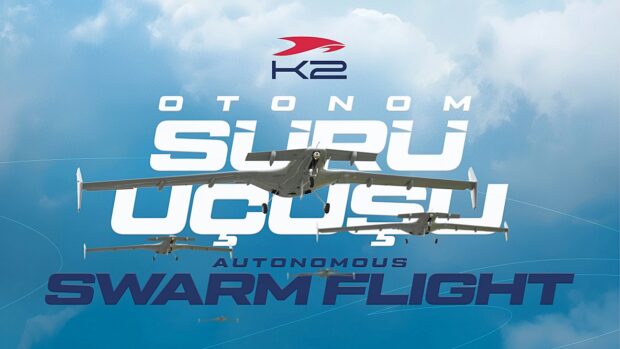
The K2 Kamikaze Unmanned Aerial Vehicle, developed by Baykar as part of its cost-effective defence strategy, has demonstrated advanced autonomy, artificial intelligence, and formation capabilities in recent testing. Flight trials conducted on March 13–14 involved five K2 aircraft operating together, showcasing coordinated swarm performance.
During multi-sortie tests over the Gulf of Saros, the UAVs successfully executed “right echelon,” “line,” and “V” formations after taking off from the Keşan Flight Training and Test Centre. Using onboard AI, sensors, and mission software, each aircraft determined its relative position within the swarm and maintained formation without error. The platform is also capable of performing additional configurations such as “Turan” and “wall” formations, highlighting its adaptability in complex operational scenarios.
Designed around AI-assisted swarm synergy, the K2 introduces a new approach to expendable UAV systems. Future development aims to produce variants capable of returning to base after deploying munitions, allowing partial reusability and increased operational efficiency.
A key objective of the programme is affordability. The K2 is intended for mass production at relatively low cost, reducing reliance on expensive munitions while enabling effective neutralisation of high-value targets.
The UAV is engineered to operate in contested electronic warfare environments. Its navigation system can function without GNSS by using visual terrain recognition through onboard cameras, including night-capable systems. This allows the platform to continue missions and navigate autonomously even under heavy signal jamming.
Equipped with an EO/IR gimbal camera, the K2 can conduct reconnaissance and achieve precise targeting through visual lock-on or coordinate-based strikes. With both line-of-sight and satellite communications, it offers strong operational flexibility.
As the largest UAV in its class, the K2 combines a maximum takeoff weight of 800 kg with a 200 kg payload, over 2,000 km range, speeds exceeding 200 km/h, and endurance beyond 13 hours.
Source: Baykar