
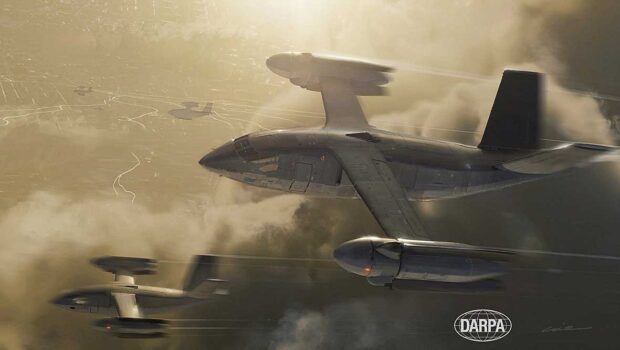
The experimental aircraft developed under the SPRINT programME has been designated the Bell X-76 and is currently being built by Bell Textron following the successful completion of its Critical Design Review in 2026. Its designation places it within the historic lineage of experimental X-planes used to push the boundaries of aviation technology.
The Speed and Runway Independent Technologies (SPRINT) program aims to develop an experimental X-plane that demonstrates a breakthrough combination of high aircraft speed and runway independence. Led by the Defense Advanced Research Projects Agency (DARPA) in partnership with United States Special Operations Command (USSOCOM), the initiative focuses on overcoming a long-standing aviation trade-off: the ability to fly fast like a fixed-wing aircraft while also operating from austere environments without a runway like a helicopter.
SPRINT entered its second development phase in May 2025 after Bell was selected to continue the program. Phase 2 focuses on manufacturing, integration, assembly, and ground testing of the X-76 demonstrator. A subsequent Phase 3 flight test campaign is currently planned for early 2028.
The aircraft is designed to demonstrate several key capabilities. These include cruising at speeds exceeding 400 knots, hovering in austere environments, and operating from unprepared surfaces without the need for traditional runways. Achieving these goals would enable rapid deployment, surprise operations, and faster response for missions such as personnel recovery, infiltration and exfiltration, aeromedical evacuation, and tactical mobility.
A defining feature of the X-76 is its proposed stop-fold tiltrotor configuration. Like the Bell Boeing V-22 Osprey, the aircraft can take off and land vertically using large proprotors mounted on tilting nacelles. However, during forward flight the rotors slow, stop, and fold back, allowing the aircraft to transition from turboshaft-powered lift to turbofan jet propulsion for significantly higher cruise speeds.
Bell has suggested that the underlying technology could scale across a wide range of aircraft sizes—from small 4,000-pound platforms to large aircraft approaching the size of a Lockheed C-130 Hercules. Both crewed and optionally piloted variants are under consideration for future operational use.
Sources: DARPA; Air & Space Forces Magazine