

In 2024, the defence ministers of France, Germany, Italy, Poland, Sweden and the United Kingdom launched the European Long-range Strike Approach (ELSA), a joint initiative to strengthen Europe’s long-range strike capabilities and reinforce NATO’s deterrence and defence posture.
The program aims to accelerate development, harmonise procurement and deepen cooperation between European armed forces and industry.
A central pillar of ELSA is the development of a low-cost loitering munition with a range exceeding 500 kilometres. Designed as a one-way attack effector for deep precision strikes, the system is intended to provide European nations with an affordable, scalable capability aligned with NATO Defence Planning Process goals and national operational requirements.
In recent months, work under ELSA has advanced across multiple capability areas, including airborne early warning systems, air-launched missile capabilities, a European multiple rocket launcher, and low-cost long-range strike systems. Some projects have reached sufficient maturity to allow the inclusion of additional European partners.
On February 12, the six defence ministers signed a letter of intent formalising their commitment to develop long-range, single-use effectors. The agreement establishes mechanisms to accelerate development and acquisition across Europe, underlining the participants’ determination to rapidly enhance collective defence.
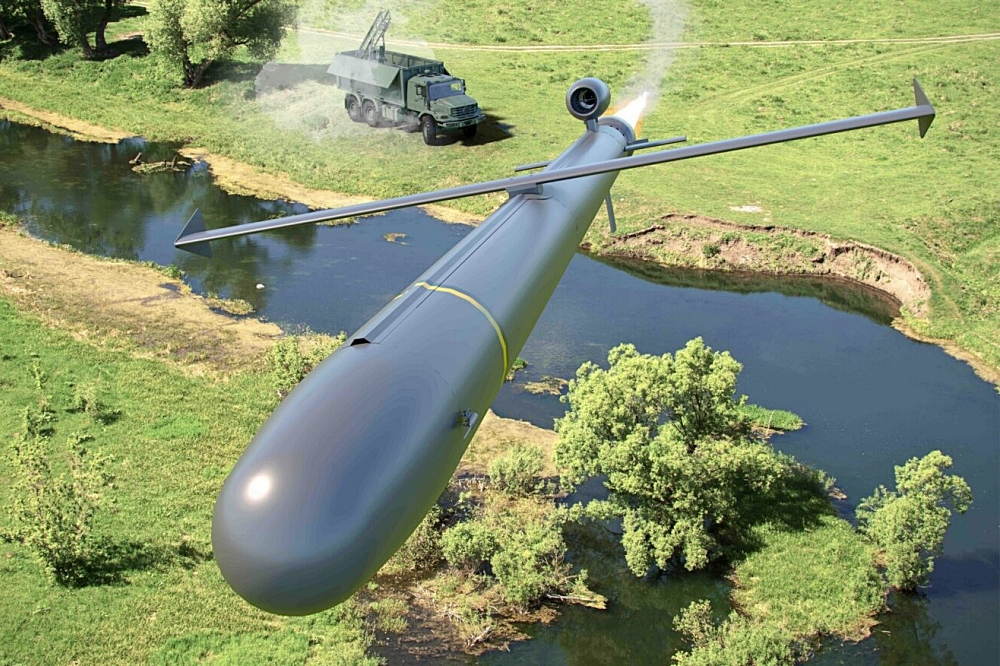
MBDA Crossbow one-way effector
Known in expert circles as One Way Effector 500 Plus (OWE 500+), the project reportedly envisions a shared, cost-effective platform adaptable to national payloads. Production would be distributed among participating countries to increase scalability and industrial resilience.
The weapon is expected to deliver a payload of roughly 50 kilograms over 500 kilometres, potentially using conventional 155mm artillery shells as warheads to reduce costs. Target unit prices are reportedly in the five-figure range, with systems capable of autonomous navigation and controlled by a single operator managing multiple launches.
Germany is expected to field the system, with plans to establish three long-range precision strike batteries in line with NATO commitments.
Sources: Ministry of National Defence, Poland; hartpunkt; Interesting Engineering