
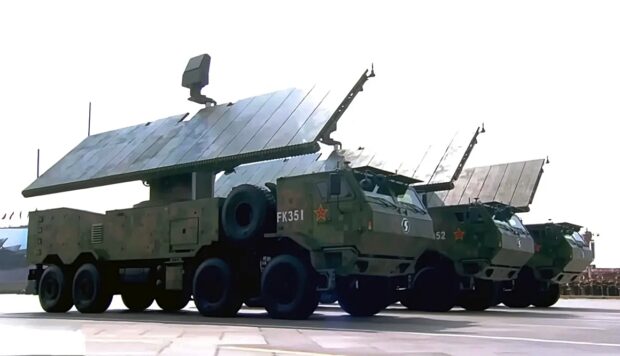
China has publicly revealed a new vehicle-mounted high-power microwave weapon, designated the Hurricane 3000, during a nationally broadcast military parade in January 2026, according to footage aired by Chinese state television.
Its appearance marks one of the rare occasions on which the People’s Liberation Army (PLA) has openly displayed a directed-energy weapon, signaling that Beijing now considers counter-drone microwave systems to be a mature and operational component of its air-defense architecture rather than an experimental capability.
The Hurricane 3000 is assessed to be a vehicle-mounted high-power microwave system capable of emitting focused electromagnetic energy to disrupt, disable, or permanently damage the electronic components of hostile drones at ranges reportedly up to three kilometers. Unlike kinetic air-defense weapons or missile interceptors, the system relies on intense microwave pulses to overload flight controls, sensors, navigation systems, and onboard data links.
It is believed to generate rapid bursts rather than a continuous beam, enabling engagement of multiple targets in quick succession and making it particularly effective against coordinated drone swarms.
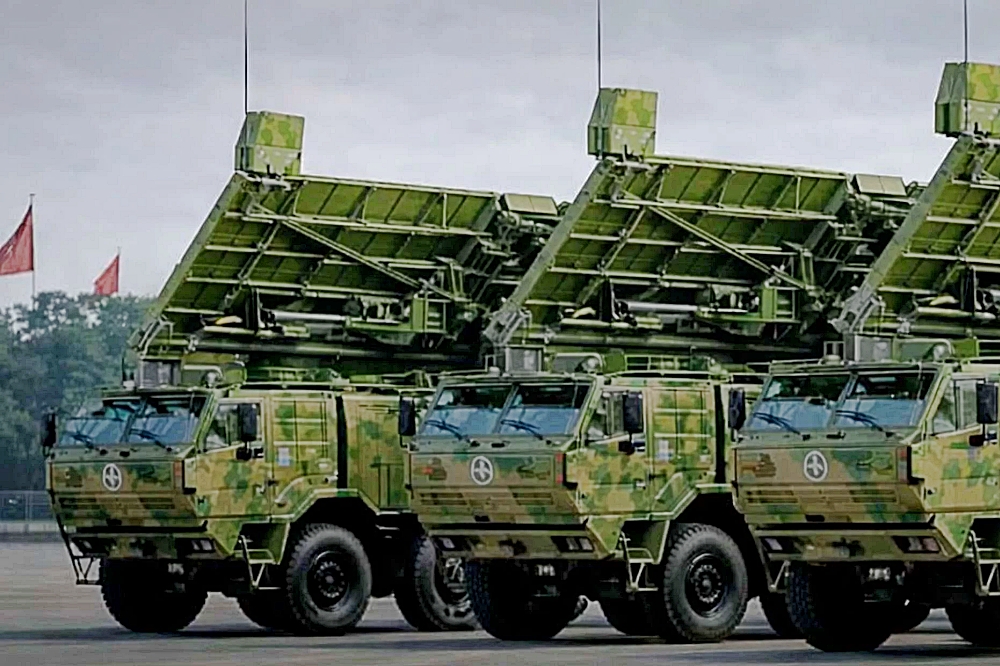
The system appears to integrate a large directional emitter mounted on a stabilized platform, supported by dedicated power generation and cooling subsystems housed within the vehicle. Analysts estimate it operates in the high-gigahertz frequency range, optimized to exploit vulnerabilities in both commercial and military-grade electronics. The absence of visible radar or interceptors suggests the system is cued by external sensors or integrated into a broader air-defense network.
Operationally, the Hurricane 3000 offers significant advantages in environments saturated with low-cost drones used for reconnaissance and strike missions. Conventional air defenses struggle with unfavorable cost-exchange ratios against swarms, while microwave weapons enable repeated engagements at minimal per-shot cost. The system could protect command posts, logistics hubs, and maneuver units, particularly in dense or urban environments, though its line-of-sight limitations indicate it would be most effective when layered with traditional defenses.
The system appears to be the culmination of more than a decade of Chinese research into directed-energy weapons. When compared with Western counterparts such as the US THOR and IFPC-HPM systems, China’s decision to parade the Hurricane 3000 suggests a relatively high level of confidence in its operational readiness, even as details of its integration and performance remain opaque.
Source: Army Recognition