
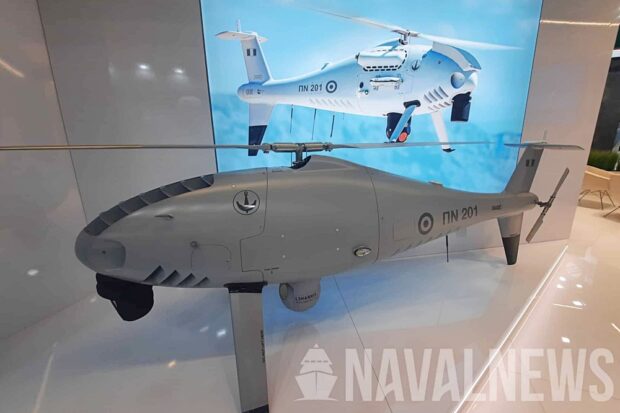
In an exclusive interview with Naval News at DEFEA 2025, Lubos Sramek, Sales Director for Europe at Schiebel, shared key insights into the S-100 CAMCOPTER Vertical Takeoff and Landing Unmanned Air System, which is set to equip Hellenic Navy’s future Kimon -class (FDI HN) frigates.
The S-100, CAMCOPTER developed by Austrian manufacturer Schiebel, has been selected for integration with Naval Group’s SETIS combat management system (CMS) aboard Greek FDI frigates, significantly enhancing the ships’ operational capabilities across multiple domains. While the contract has not yet been signed, it is expected to be finalized in the coming months.
Naval News: Can you please tell us why the S-100 is the best choice for the Hellenic Navy?
Lubos Sramek:
For modern navies, rotary-wing aircraft remain the natural choice for multi-role operations at sea. Schiebel is the world leader in rotary UAS with unrivalled experience. Schiebel’s S-100 Camcopter, a high-performance unmanned aerial system (UAS), stands out as the only unmanned helicopter currently in both serial production and operational service. With over 540 units produced, it has become a preferred choice for maritime forces worldwide. The first helicopter for Hellenic Navy will be number 545!
The S-100s will be seamlessly integrated with the FDI’s CMS, enabling full operational interoperability. With these new tools, the Hellenic Navy will increase the surveillance, detection and identification capabilities of its surface vessels significantly. The S-100 will execute these tasks equipped with an L3 Wescam Electro-Optical / Infra-Red (EO/IR) camera gimbal, an Overwatch Imaging PT-8 Oceanwatch payload and an Automatic Identification System (AIS) receiver.

In March 2025, Greek MoD Nikos Dendias visited the UAS Schiebel manufacturing facility in Austria, where he was given a tour by the Managing Director and owner of the Company, Hans Georg Schiebel. He was also given a demonstration of the S-100 UAS that will equip the Greek FDI frigates. In the photo the first S-100 for the Hellenic Navy. Photo by Nikos Dendias on LinkedIn
Naval News: Could you elaborate on how the S-100 UAV is being integrated with the FDI frigates?
Lubos Sramek:
Naval Group has extensive experience integrating the S-100 system across its platforms. The Camcopter has already been successfully integrated on Gowind-class offshore patrol vessels (OPVs) and all Mistral-class landing helicopter docks (LHDs), including those operated by Egypt (In 2019, the French LHD Dixmude became the first European ship that fully integrated a rotary wing UAV to its CMS).
For the Hellenic Navy, the S-100 has been selected for operation aboard the new FDI HN frigates. These ships are being constructed with full provisions for the system from the outset, allowing seamless integration with the SETIS CMS and enabling the UAS to deliver its full operational potential in real time. Inside the FDI’s PSIM mast cone, a dedicated communications antenna is pre-installed, similar to that of the Gowind-class offshore patrol vessels.
The installation process is quick and simple; trials on the Elli (Kortenaer)-class frigate Aigaion (F-460) demonstrated full integration in less than a day with the workstations placed withing the hangar. So, even if the system is not installed, you can do it if you have the right cabling. The Navy expressed strong satisfaction with the system’s performance during evaluations in a list of tasks and measured performances.
Naval News: Can you provide us some details about the system and the CONOPS?
Lubos Sramek:
Each S-100 system consists of two S-100 air vehicles (note: both housed in FDI’s dedicated hangar) with multiple payloads, a control system with two workstations and data link. Only one vehicle is needed for most missions, while the second ensures high availability (over 90%) or undergoes maintenance. Note that one helicopter can perform one role (for example launches sonobuoys for coastal surveillance) while the second one a different role (equipped with a data relay box, it optimizes the transmission range of data from acoustic buoys deployed). A total of four systems will be delivered to Greece—each comprising two UAS. Three systems will be deployed aboard the FDI frigates, while the first system will initially be land-based at Marathon for training purposes. The Navy retains flexibility to later assign this system to a fourth frigate or keep it ashore for training and will will buy a fifth system.
Installation of the systems will be handled by Naval Group (NG) in Greece, with all necessary cabling and integration work performed locally. The first system is expected to be delivered immediately upon contract signing. We estimate that the first delivery will take place this summer. Each frigate will receive its S-100 system shortly after arrival, allowing for timely integration and deployment.
With the arrival of the first FDI frigate Kimon in Greece, and the upcoming installation of the S-100 systems, the Hellenic Navy is set to enhance its operational flexibility and surveillance capabilities significantly.
Naval News: What about the system’s maintenance?
Lubos Sramek:
Maintenance will be largely handled by the Hellenic Navy itself, except for select components like the engine and gearbox, which require periodic overhaul in Austria. These can be swapped out onboard, with a turnaround time of under two days for removal and replacement, and about a month for engine servicing. The helicopters will never have to return to Austria for maintenance!
If you are in a mission and you need to perform any maintenance, you remove simply the payloads of the 1st helicopter and you move them to the 2nd one in about an hour. In this way, the system achieves well over 90% operational readiness.
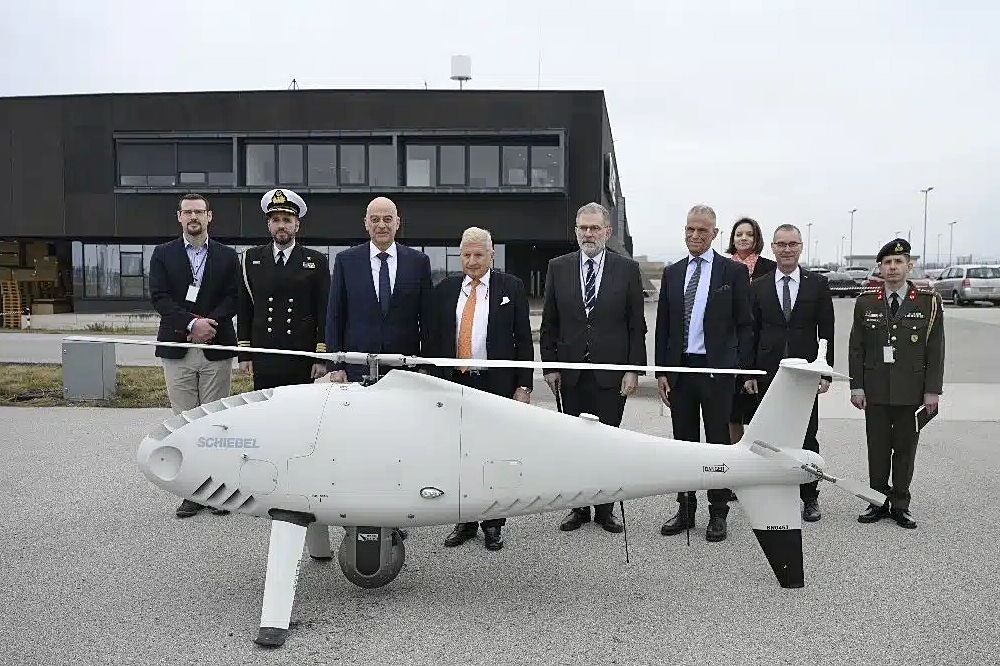
In March 2025, Greek MoD Nikos Dendias visited the UAS Schiebel manufacturing facility in Austria, where he was given a tour by the Managing Director and owner of the Company, Hans Georg Schiebel. He was also given a demonstration of the S-100 UAS that will equip the Greek FDI frigates. Photo by Nikos Dendias on LinkedIn
Naval News: Why the Hellenic Navy did not select the S-300, the larger version of S-100?
Lubos Sramek:
The S-300 was not selected for the FDI HN program as it had not yet flown when the decision was made. Its maiden flight occurred in February 2025, with initial deliveries expected to our first customer for this UAS, South Korea, in 2026 and contract completed in 2028. The S-300 offers reduced maintenance needs and a heavier payload, especially for ASW operations, but shares the same infrastructure as the S-100, allowing for an easy future transition if desired. So, if the HN desires in the future to move on with the larger S-300, it is a very easy and quick process as the same workstations and general infrastructure is used for both systems.
Source: Naval News